Manet Uphended Art Traditions the Luncheon on the Grass
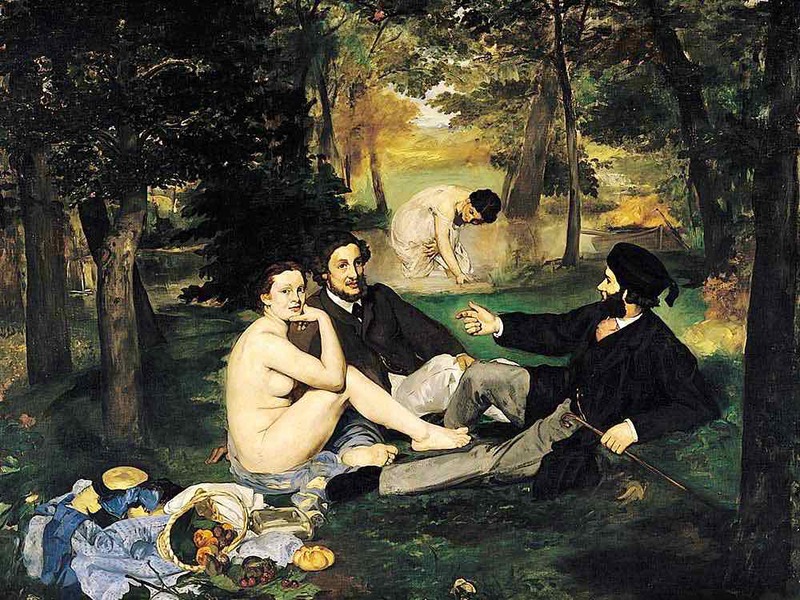
The massive Lunch sur l'Herbe was inspired by classical paintings, but with a huge contemporary twist.
Manet in 1862
By 1862, when Edouard Manet started Lunch sur fifty'Herbe, Manet was xxx years old. He had already led an interesting life, having joined a merchant navy expedition to Rio, studied painting in a Parisian studio, and had mixed results when he submitted his works to the annual exhibition of the French Fine Arts Academy.
The key affair to note is that Manet was not at this stage an established painter. Instead, he was desperately trying to make his name.
The scene
The almost striking affair nigh Manet's canvass is the naked adult female in the foreground. She is painted completely at ease, staring unapologetically at the viewer. The eye is and so fatigued to the ii clothed young men lounging with her: they are not from classical times but dressed in the latest Parisian fashions.
As the French author Michel Deon put it:
"The existent scandal lies not in the naked adult female simply in the fact that her two companions are fully dressed. Had they been naked likewise they would barely raise an eyebrow. Among friends, Manet called his painting The Foursome. Yeah indeed, what are these ii dandies waiting for to indulge in the pleasures of their hedonistic lives?"
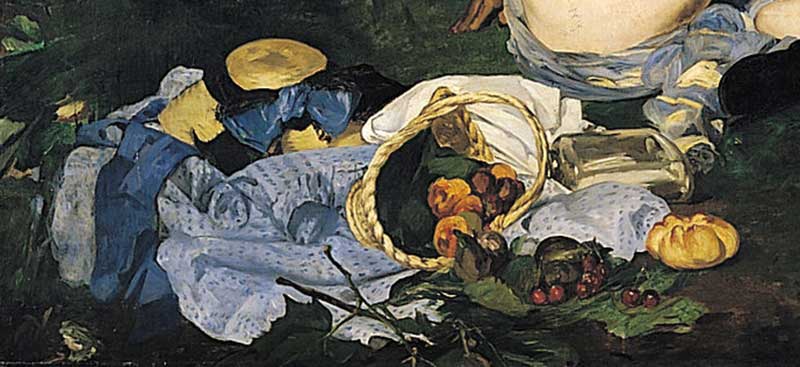
Closer inspection reveals the woman's hat and clothes strewn on the flooring (bottom left of the painting) and a picnic handbasket that has been knocked over – with staff of life, peaches, cherries and even (it seems) an oyster on the forest floor.
The next matter to note is the woman in the mid-ground. She is wearing some sort of dress, perhaps a nightdress and appears to be bathing. But why if this is really a painting of a picnic? And why is in that location a rowing boat side by side to her?
The viewer so sees that either the clothed woman in the mid-ground is a giant or that something has gone incorrect with the perspective of the picture.
Farther inspection reveals that:
- the forest canopy has been painted with wide castor strokes and seemingly very quickly (these are key impressionist traits).
- the painting appears to be very 'flat', with the the naked flesh of the chief character painted in a uniform and bright tone and without much shadow.
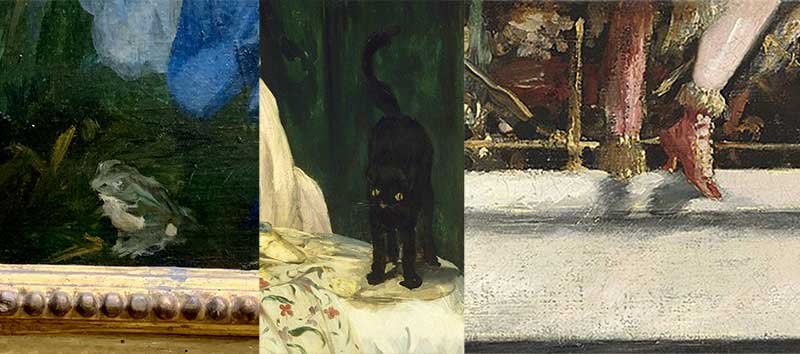
Finally, and I only noticed this when looking at the original in the Musee D'Orsay, ane notices a beautiful cherry-red-breasted bird flying above the central scene and a little frog on the bottom left mitt corner.
Interesting fact...
Manet liked hiding little jokes in his paintings. In Dejeuner sur l'Herbe information technology is a frog in the bottom left hand corner, in Olympia it is a cat with a raised tail painted in the shadows, and in Masked Ball at the Opera it is the dangling legs of an acrobat at the peak of the painting!
The size
Another striking aspect of the moving-picture show is its size: the sail measures 208 x 264.5 centimetres. In other words, the characters are almost life-sized. This must have contributed to the impact the painting made on critics and the public.
Inspiration
Manet drew inspiration for his painting from the old masters, who he had spent years studying in the Louvre. There are detail parallels between Dejeuner sur fifty'Herbe and Raphael's Judgement of Paris and Titian'due south Pastoral Concert, below.
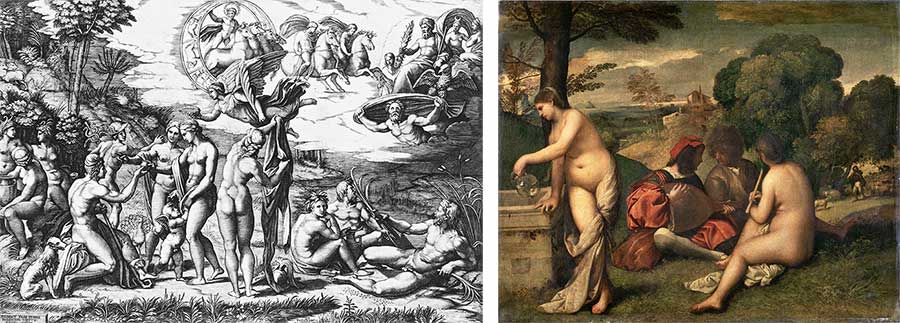
But Manet's have was very different: he painted a contemporary scene; and his nude wasn't looking coy or engrossed in activity - she was studying the viewer studying her!
What'south in a name?
When Tiffin sur fifty'Herbe was exhibited in 1863 Manet gave it the name "Le Bain" or "Bathing" in English. This didn't make much sense every bit the central figures were lounging on the woods floor having a picnic.
Manet afterward changed the name to 'The Square Function' and finally settled on Dejeuner sur 50'Herbe (Luncheon on the Grass).
But Manet's informal proper name for the painting, The Foursome (La Partie carree), is probably more than accurate!
The figures
Art historians are able to place three of the four figures in the scene (not the clothed female person in the background). They are:
- Victorine Meurent (1844-1929?), i of Manet's favourite models - a nineteen yr old living in Montmartre, who also appears in Manet'due south Olympia.
- Manet's younger brother, Eugene Manet (1833-1892) (sitting next to Victorine). (In fact, Manet spent so much time working on the painting that his other brother, Gustave, had to deputise for Eugene!)
- Ferdinand Leenhoff (1841-1914), Manet'southward blood brother-in-law.
andersonhonsintepher00.blogspot.com
Source: https://impressionistarts.com/edouard-manet-dejeuner-sur-lherbe
0 Response to "Manet Uphended Art Traditions the Luncheon on the Grass"
Post a Comment